Every once in a while in the present, you look back with fond memories on something you experienced in the past. It may be an event, a film, a book, a game, anything.
Then you realise that, wow, that experience has been reincarnated once again in modern times. I had that same feeling today.
We’re currently working on a top secret large web development project for a client, and it’s at the stage where a particular aspect of user engagement is key. So along comes an obvious solution, gamification. We’ve just finished the initial research about how gamification might work in terms of points, levels, statuses and badges, and the overall gaming journey. Through a combination of approaches, a member can complete various tasks and earn a higher ranking against their profile as a reward for their increased engagement with the website.
 Increased usage helps drive more traffic around the website, which engages members more, who will likely tell their friends about the site, so more people visit the site, sign up, and we create a larger membership base, a bit like a chain reaction with users flocking to the site. So it seems that effective gamification might also help our organic Search Engine Optimisation (SEO) as well.
So back to my experience
Which comes from a long time ago, in a computer game from several galaxies far far away – it was way ahead of its time.
 Some of you reading this might recall the following…The first challenge of the game was how to load it up. After deciding you wanted to play the game, the security process for ensuring you had a genuine copy of the game was that you were asked to enter a word, taken from the game’s manual, which was randomly selected as say, the third word in the second paragraph on page 76. Enter the correct word and you were granted access to the game. Instant engagement.
Within the game, which was based in space across several galaxies, it concerned buying cargo from one planet and selling it at a profit on another planet. However, to achieve this quite simple objective, which you can equate to being as simple as destroying an ancient ring by throwing it into a fire in a mountain, you had to master several tasks. You had to learn how to fly different spacecraft, all of which flew slightly differently in terms of speed, turning ability, power, and other types of capabilities. Then you had police vipers and pirate spacecraft hunting you down, who either wanted to uphold the law or who wanted to steal your valuable cargo. Your spacecraft took on damage when they fired at you as the protection from your shield wore off, and it was a task in itself just to get to the space station you were flying towards, nevermind manually landing the craft before you could afford to upgrade to an automatic docking computer. You also had different value cargo with varying levels of risk, so it was a highly strategic decision about which combinations of cargo presented the greatest risk in terms of the planets you flew it to, and whether on your journey you would be captured or shot down. Enemy craft might not shoot you down for food, but they certainly would do for transporting narcotics.
As you achieved success on more increasingly difficult journeys, increased your money, bought some cool equipment such as more powerful lasers and missiles, destroyed trickier enemy aircraft and visited more far off places, you earned a new rank, always striving to get to the Elite status.
And wait for it as it gets better, it was played in 3D…30 years ago!
The game is of course the majestic, Elite.
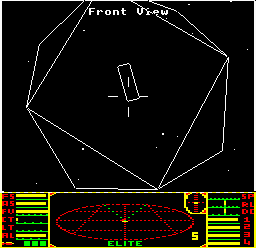
Just to put into perspective how revolutionary this game was, it ran on an 8 bit computer typically with 64KB of memory. Today’s computers typically run on 32 or 64 bits, and a standard laptop might have 8GB memory, that’s 8,000,000 KB!
So what can we learn from this trip down memory lane?
There are several options for gamification, for small websites up to large corporate installations, and it’s a massive industry. The title of this post gives you some links to the big players, Captain Up, Gigya, Badgeville and BadgeOS.
What’s most important, like with any project, is careful planning to ensure that you are using the right gaming techniques for your audience. Some questions we’ve found useful to ask during our planning process are:
- What are the actions users take on the website which they should receive points for?
- How many points should they receive per action?
- What levels should there be?
- How many points should the user need to earn before they reach each level?
- How can a user boost the amount of points they get?
- How can we increase engagement across a whole range of different site activities?
- How can people cheat the system, can we put in place protection mechanisms against this?
- How attainable is each level based on the number of people you estimate will be participating? How many members do we want to achieve Elite statuse, because in any walk of life there are only ever a handful of experts
- How will you entice and motivate users to keep going, to get to that next level, and through what means – are there any point boosting methods they might not know about?
- Are there any elements of the gaming system which are at conflict with how different users might use the website – have we performed a robust analysis on our target audience combined with effective market research?
Think about how the different facets of your gamification plan come together, do they all support your goal when you first set out?
When it’s done well, gamification is highly effective, but like anything in business it needs careful planning to make sure you are creating something that your audience will understand, will then desire, and will then want to achieve. Follow the link below to Wikipedia to read a full overview of just how well planned out Elite was, and how much effort must have gone into the thought process behind it.
I played Elite a lot, and I played it quite well, but I never got to Elite status, did you? Let us know by posting a comment below.
I’ve given a brief overview of Elite’s gameplay which came to memory during writing this post – check out Wikipedia’s rich description of the game’s intricacies. There’s a video trip down memory lane from YouTube as well.
Thanks for reading.